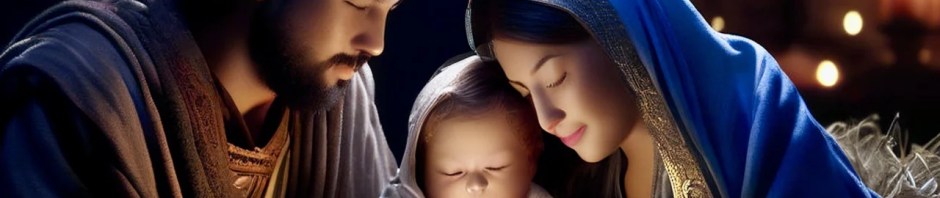
AS the Christmas season approached last year, we invited our readers to join us in making a mental journey back to 1st Century Israel. Our intention was to walk alongside the cast of characters and watch the story unfold as it would have in the Middle Eastern culture that existed at the time. We believe the story of God coming into the world in human flesh deserves to be seen in the well researched ‘context’ of the world in which it actually happened. Laying aside some of our traditional perspectives to take a fresh look at the events might seem a bit awkward, but it can help us experience the story with a heightened sense of realism and authenticity.
Most importantly, as we think about the active participants in the Christmas narrative, let’s be careful not to forget the One who actually orchestrated it all. It’s not just a dramatic engagement involving Mary and Joseph and some shepherds and angels. It’s the story of God bringing His Son into a lost, hopeless, and violently oppositional world. Because the contexts (historical, cultural, geographical, linguistic, visual, and literary) are so important to better understanding the richness and beauty of the birth of Christ, we invite you to join us again this year as we revisit last year’s five-part Christmas series by traveling first to Nazareth for a re-introduction to one of the first and most important characters in God’s story … an amazing young girl named ‘Mary’.
________________________________________
THIS is the time of year when we not only start pulling Christmas decorations out of our attics and storage facilities, but it’s also the season when we unpack and dust off our favorite Christmas traditions and put them on display again. Let me say up front and unapologetically that I love traditions. I love the traditional lights and sounds that characterize Christmas. I love the special recipes that somehow don’t fit in other seasons. I love gathering with family and friends at those times and places that we try to reserve as much as possible every year. I love the way the sights and sounds and smells become time machines that take me back to cherished events and priceless moments.
Traditions Can Be Confusing ~
But as much as I love traditions, I don’t love the way they can sometimes reinforce and encourage the support of confusing fantasies. Familiar, but inaccurate, renditions of events can deny reality, obscure meaning, and suppress enlightening truth. Traditional stories laced with fictional content can serve to erect barriers to understanding, rather than opening doorways to things that facilitate and enhance it. So many of our wonderful Christmas celebrations certainly ought to be preserved, but some of the traditional expressions associated with the event don’t necessarily lead to deeper understanding.
The Christmas story is one of the most significant and holy interactions God ever had with human beings, and we don’t want to miss out on any of the lessons God wants us to learn. For that reason, I feel compelled to devote our posts between now and Christmas to revisiting the traditional story and allowing ourselves to experience a fresh introduction to some of the characters and elements involved and to see them as they really were. My desire is to encourage us to revitalize and revive the real Christmas story, rather than revise it by wrapping parts of it in traditionally entrenched, culturally popular, but largely fictional trappings.
An Indisputable Fact ~
I’m aware that questioning the accuracy of some of the familiar and cherished scenes etched into our minds may not be received necessarily as a welcome thought. But there’s one  fundamental, indisputable fact that we should all remember. The Christmas story is, after all, God’s story, not ours. He is the Originator, and He owns all the rights. He’s the Author, Producer, Director, Set Designer, Casting Coordinator, Scheduler, and Holder of an indisputable copyright that will never expire. Embracing the story and its characters as God really presented them highlights how God can work in and through the realities that exist in the world at any point in time. That’s a clear reminder that He will work out His plan for us in whatever conditions exist in the real world we live in today, just as He did for Mary and Joseph back then.
With that in mind, I encourage you to read Luke 1:25-38 for the full account of Mary’s interaction with the angel, but we’ll begin here by reviewing where and how her part of the story began:
Now in the sixth month the angel Gabriel was sent by God to a city of Galilee named Nazareth, to a virgin betrothed to a man whose name was Joseph, of the house of David. The virgin’s name was Mary. And having come in, the angel said to her, “Rejoice, highly favored one, the Lord is with you; blessed are you among women!”
But when she saw him, she was troubled at his saying, and considered what manner of greeting this was. (Luke 1:26–29 NKJV)
The real Mary that God chose was quite different from the way she’s often portrayed. She wasn’t some wistful, delicate young woman dressed in flowing robes with a scarf neatly folded over her head. She didn’t spend her days gathering flowers, writing poetry, cradling little lambs in her arms, and daydreaming about the kind of future she’d have with her fiancé.
Not What We Expected ~
Truth is, Mary was nothing like that. On the outside, she couldn’t have been more ordinary –no flowing robes, no fancy scarves, and very little idle time. Mary was the simple, plainly dressed, unpretentious, hard-working daughter of a nondescript, lower class Jewish family who lived in a small, insignificant town in northern Israel. Her days were strictly regimented and revolved around working through the exhausting chores required to sustain life and practicing the customary prayers and rituals of Jewish life as she had been taught. But though she might have been plain and unimpressive on the outside, on the inside, Mary was the antithesis of ordinary. She was a living composite of those characteristics that bless the heart of God.
Mary was both spiritually strong and physically tough. Few, if any, conveniences existed in her world. She couldn’t turn on a tap and get water, and she couldn’t strike a match or flip on a lighter to start a fire. There were no automatic ovens with timers for baking the bread everyone expected every day. She didn’t have a washing machine, and there was no box of little detergent pods to clean the clothes. And as if those things weren’t challenging enough, Mary didn’t have a cabinet full of specially-formulated products for personal hygiene. She didn’t even have good lighting and a decent mirror to check on her complexion or to see if she was having a bad hair day. If the whining snowflakes in our day who think they’re “oppressed” because somebody they don’t know says something they don’t like had to live a few days in the world Mary faced every day, they’d probably be suicidal.
A Normal Situation ~
Life like that would be hard even for a woman seasoned by years of experience, but that’s not who Gabriel dropped in on. Instead, the girl whose life he up-ended that day would be considered just a kid in our culture. Mary was at the age when young Jewish girls in that day normally began the process of becoming wives and mothers, which was approximately 13 to 15 years old. She would have already completed her formal Torah studies and mastered the tasks associated with running a home. And as would have been expected in that culture, she was betrothed to a 17-20 year old Jewish boy who had been working with his father and was beginning his career.
The Jewish betrothal period that Mary and Joseph experienced wasn’t like the engagements we’re familiar with in our culture. Betrothals were consensual, but the couple’s decision to  marry would have been heavily influenced by their parents and the prevailing social, religious, and financial customs. For instance, betrothed couples were officially and legally considered to be husband and wife during that stage, which could last a year or so. No touching was allowed during that period. They were not permitted to be in each other’s presence without a chaperone to ensure that no “hanky panky” got started until the final marriage ceremony was completed. So, the only similarity between their courtship and one of our modern-day Hallmark movies is that it wasn’t particularly thrilling to witness, and as you might suspect, nobody got to kiss anybody ‘til the end!
A Challenge for You ~
It’s clear that the exchange between Gabriel and that Jewish teenager wasn’t recorded just for them. So, to close out Part 1 of our 5-part cultural context series, let me ask you to think about how God might use the messages it conveys to involve you in His redemptive plan right now. I’ll offer a few ways to get you started, but I challenge you to reflect on this incredible interaction again and add your own:
-
- In a culture obsessed with external appearances and superficial judgments, we need to remember that Mary wasn’t chosen because of what she looked like. Enduring value wasn’t determined by external appearances then – and it isn’t now.
- Faith and courage aren’t dictated by age, gender, or socio-economic status. Mary’s faith prepared her heart to receive things her mind could not comprehend, and the Son she brought into the world offers us that same possibility.
- For Mary, being lifted to heights unimaginable began by accepting the lowest status possible in that culture, one of total submission and dependence.
Given today’s focus on self-promotion and finding some easy path to wealth, stardom, and luxurious living, Mary’s humble, faithful, and courageous submission seems shockingly countercultural. But no degree of wealth or fame the world could ever offer could touch the glory that God had bestowed on her. And though there can never be another role quite like Mary’s, her example of faithful submission and obedience can be replicated by all of us. A response like hers will always lead to a glorious partnership with the Son she bore who will lead us to heights we could never achieve on our own.
~ ~ ~ ~ ~ ~ ~ ~ ~ ~ ~ ~ ~ ~ ~ ~ ~ ~ ~ ~ ~ ~ ~ ~ ~ ~ ~ ~ ~ ~ ~ ~ ~
We hope you’ll return next week, as we continue to revisit and further unfold the original Christmas Story in Part 2 by exploring Mary and Joseph’s culturally surprising journey from Nazareth to Bethlehem.
I’d love to hear some of the insights and reactions you might be willing to share. Just post them in our response section.
“TWEETABLES” ~ Click to tweet and share from the pull quotes below. Each one links directly back to this article through Twitter . . .
-
-
- Embracing the Christmas story and its characters as God really presented them highlights how He can work in and through the realities that exist in our world at any time. He’ll work out His plan for us in whatever conditions exist where we live. @GallaghersPen (Click here to Tweet)
- In a culture obsessed with external appearances and superficial judgments, I need to remember that Mary wasn’t chosen because of what she looked like. Enduring value wasn’t determined by external appearances then, and it isn’t now. @GallaghersPen (Click here to Tweet)
- Faith and courage aren’t dictated by age, gender, or socio-economic status. Mary’s faith prepared her heart to receive things her mind could not comprehend, and the Son she brought into the world offers us that same possibility. @GallaghersPen (Click here to Tweet)
-
To follow this blog for more “Right Side Up Thinking ~ In an Upside Down World” …
Sign up just below the Search box in the upper right sidebar for regular email notifications of new posts.
And to “Share Your Thoughts,” continue scrolling down …
 Check out Ron’s book, “Right Side Up Thinking in an Upside Down World ~ Looking at the World through the Lens of Biblical Truth”


 Gallagher's Pen ~
I love going back in time with you, Ron, to revisit how the Jewish culture of that day shaped Mary’s sense of faithful belief and obedience. She was, indeed, a strong woman, inside and out. And she was willing to face social shame and even stoning in order to fulfill God’s plan of salvation. That’s courage! I’m looking forward to the next installment. Blessings!
LikeLike
So good to hear from you as always, Martha, and especially at a time of year when we’re already focused on the joy God has blessed us with through our family, friends, and those special people God has brought into our lives. I wish you and Danny could have been with us Last night. Diane and I and several hundred others gathered at our church to hear my favorite cultural historian, theologian, gifted communicator, and friend spend about two hours going through the Christmas story in its historical, linguistic, geographic, archeological, and of course, cultural context. The information wasn’t new, of course, but every time I pause to reflect on those events, I’m freshly amazed at what an incredible demonstration of love it was and is. We have so much to celebrate, and we’re blessed to be able to share it with folks we’ve grown to love like you and Danny and your beautiful family. As Advent 2025 unfolds, may the marvel of the real story, the real circumstances, and the real outcome of that first Christmas lift our hearts to heights beyond anything Hallmark’s Christmas movies could ever touch.
LikeLiked by 1 person