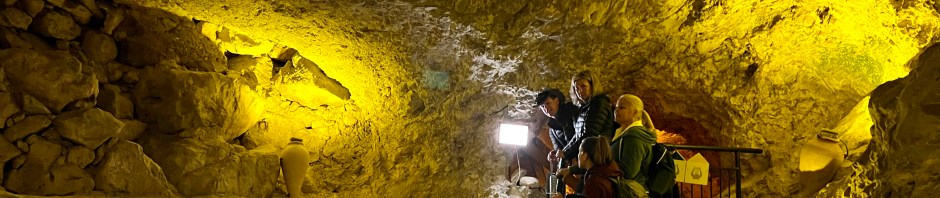
I’m sitting here in the comfort of my favorite writing chair reflecting on our recent trip to Israel, and in particular, our second walk through “Hezekiah’s Tunnel,” built around 700 BC. I can close my eyes and almost feel the water that was rushing against my legs. The persistent current resisted every step as Diane and I made our way through the dark, narrow passageway underneath the remains of the ancient wall of that part of Jerusalem called the City of David. The tunnel was laboriously chiseled by hand through solid rock some 2,700 years ago and represents an engineering marvel that is nothing short of miraculous. The Bible only mentions the tunnel a couple of times, and as you can see from the example that follows, the references are brief and provide virtually no details about the project itself.
Now the rest of the acts of Hezekiah—all his might, and how he made a pool and a tunnel and brought water into the city—are they not written in the book of the chronicles of the kings of Judah? So Hezekiah rested with his fathers. Then Manasseh his son reigned in his place. (2 Kings 20:20–21 NKJV)
Lessons From Antiquity ~
For Diane and me, it was our second trek through the dark, wet passageway and each time, it was almost like going through a time warp that connected us to a world dramatically different in many ways from our own. Yet in spite of those differences, that ancient world sometimes has a way of revealing principles and teaching us things that are as vital to us today as they were to God’s people centuries ago.
For instance, sometimes the most impressive things we ever accomplish are preceded by a sense of desperation. But desperation is not necessarily either synonymous with surrender or the prelude to a panic attack. The God who fashioned us in His own image prefers to use desperation like a shot of adrenaline to those parts of us that make us creative – like Him. Desperation can awaken us to mental, emotional, spiritual, and physical capacities we didn’t know we had. It can make us willing to challenge impossibilities, materialize intangibles, defeat the giant, find a pathway through the maze, move mountains, or hand-chisel a tunnel that’s 2’ wide, 5-6’ tall and 1750’ long – all through solid rock. (That’s nearly the length of six football fields, by the way!)
“Do or Die” Time ~
There was certainly plenty of cause for desperation in Hezekiah’s day. God’s people were being targeted for destruction by the Assyrians, a nation known for the heartless cruelty  and suffering they inflicted on those they conquered. Samaria and several Judean cities had already fallen to them, and now Jerusalem was in their crosshairs. It was “do or die” time for the Jews in Jerusalem. Even though Hezekiah had reinforced Jerusalem’s walls and other defenses, they were vulnerable to an extended siege because there was no source of water available within the city walls. Weapons and walls provide no defense against dying of thirst.
So, for God’s people, it was time to give all they had, because all they had was precisely what they would lose if Jerusalem fell to the Assyrians. The Gihon Spring just outside the city walls provided a more than ample water source, but going beyond the walls meant certain death. Bringing the water inside would require going beneath the walls and that seemed impossible. But as Hezekiah told his people regarding the King of Assyria:
With him is an arm of flesh; but with us is the Lord our God, to help us and to fight our battles.” And the people were strengthened by the words of Hezekiah king of Judah. (2 Chronicles 32:8)
Divine Intervention Involved ~
God’s people undertook a feat of engineering, manpower, and dogged persistence that most would have considered impossible. Now, 2,700 years later, it remains a marvel to all who see it. Two teams of workers were dispatched, one from inside the city and the other from outside. With no modern equipment, no decent lighting, stale air tainted with smoke from their oil lamps, no room for carts or animals to pull them, they labored against the clock day and night. Divine intervention is the only explanation for how the two teams, with no way to communicate with each other, managed finally to reach a point within only a few yards of each other to actually ‘hear’ the chiseling on the opposite side – and ultimately open the way for life-saving water to flow all the way through!
But other than marveling over the accomplishment, is there anything we can glean from the episode that could benefit us here and now? Here are a few suggestions I think are worth considering . . .
Taking the Enemy Seriously ~
First, we may not see ourselves as being targeted for destruction like the Jews in Hezekiah’s day, but we must realize that we have an enemy devoted to our destruction. He often disguises  himself as a political icon, or an ideological advocate, or a promoter of some sexual practice. He might represent a religious affiliation, a socio-economic status or an ethnic background. Regardless of the disguise our enemy employs, his true identity and intentions do not change. Peter described him perfectly with this familiar warning:
Be sober, be vigilant; because your adversary the devil walks about like a roaring lion, seeking whom he may devour. (1 Peter 5:8 NKJV)
This enemy isn’t coming to negotiate with us. He’s coming to deceive us – and then to feed on us. He wants to defeat God’s redemptive purpose, to ensure our destruction, and to indulge his voracious, insatiable appetite in the process.
Walls Can’t Keep Us Alive ~
So, here’s the point. Like Hezekiah’s people, we have some walls that we, in a sense, surround ourselves with and that we trust to protect us. In our case, they look like
-
-
- church buildings
- sanctified rituals
- memberships
- certificates
- denominational affiliations
- ecclesiastical bureaucracies
- religious traditions
- creeds
- political alignments
-
While these things aren’t necessarily bad and may hinder the enemy to some extent, they cannot provide that life-sustaining spiritual substance we need to survive and thrive and that enables us to live in peace and harmony with others. If the enemy can’t manage to destroy our walls, he’s happy to wait until we slowly dehydrate and choke to death surrounded by the dry, dusty relics of misplaced faith. So, what do we do to prevent that? Hezekiah has an answer.
First we acknowledge that the source of the life-sustaining water we need is close by, but we have to go outside the walls to get it. As Jesus told the woman at a well in Samaria.
Jesus answered and said to her, “Whoever drinks of this water will thirst again, but whoever drinks of the water that I shall give him will never thirst. But the water that I shall give him will become in him a fountain of water springing up into everlasting life.” (John 4:13–14 NKJV)
Like the Jews working on Hezekiah’s tunnel, we don’t create the water or control its source. Our job is to do whatever it takes to get the life-sustaining water where it needs to be. We live in a culture that has been taught to mistake religious practices and performances as the wellspring from which spiritual life flows and to think that brief, two or three sentence prayers repeated systematically are the key to securing eternal life. The water is Jesus Himself, and access to Him is the only thing that can satisfy the thirst our souls experience.
The enemy is patient and he isn’t going away, so isn’t it time for us to join Hezekiah and generate some tunnel vision of our own? It’s time to believe that the living God we serve can enable us to accomplish impossible things and do whatever needs to be done to accomplish His redemptive purpose. It’s time to believe that He will place our chisels, guide our hammers, strengthen our arms, and grant us the endurance we need. When we work together and trust God’s guidance, the water of life will flow freely again. Thirsty souls will be refreshed and satisfied – and the enemy’s strategies will be repelled.
“TWEETABLES” ~ Click to tweet and share from the pull quotes below. Each one links directly back to this article through Twitter . . .
-
- We have an enemy devoted to our destruction … Regardless of the disguise he employs, his true identity and intentions don’t change. Peter described him perfectly with a familiar warning in 1 Peter 5:8 … @GallaghersPen (Click here to Tweet)
- This enemy isn’t coming to negotiate with us. He’s coming to deceive us and then to feed on us. He wants to defeat God’s redemptive purpose, to ensure our destruction, and to indulge his voracious, insatiable appetite in the process. @GallaghersPen (Click here to Tweet)
- If the enemy can’t manage to destroy our walls, he’s happy to wait until we slowly dehydrate and choke to death surrounded by the dry, dusty relics of misplaced faith. So, what do we do to prevent that? Hezekiah has an answer. @GallaghersPen (Click here to Tweet)
To follow this blog for more “Right Side Up Thinking ~ In an Upside Down World” …
Sign up just below the Search box in the upper right sidebar for regular email notifications of new posts.
And to “Share Your Thoughts,” continue to scroll down …
 Check out Ron’s book, “Right Side Up Thinking in an Upside Down World ~ Looking at the World through the Lens of Biblical Truth”


 Gallagher's Pen ~
This is such a detailed and superb analogy, Ron! As I’m just about to reach 2 Kings in my Bible reading, I will certainly focus my attention on Hezekiah in a new and refreshing (pun intended) way. The Living Water that is Jesus must be available to us on a daily basis as we guard ourselves against the enemy’s schemes to have our wells of faith run dry. They’ll never be extinguished when we cling to the One who will always quench our spiritual thirst. Blessings always!
LikeLike
Thank you for the blessings, and the encouraging feedback, Martha, and also for sharing where you are in your reading. I love reading the history of God’s interaction with His people and discovering new ways their experiences can expand our understanding of the living God and enrich our lives today. Sometimes I look back over my life and feel such a sense of loss because of all the years I spent reading those accounts without thinking about what it was like in the world they lived in, and how many things God enabled them to accomplish that were, and are, beyond astounding. For Diane and me, to have been able to make a couple of pilgrimages to “God’s homeland” and to be better able to appreciate the obstacles God’s people were often up against, what it meant to be a Jew in those days, and how much there is to learn from their experiences that affects us here and now. But our challenge, and God’s desire for us, is not to wallow in remorse and regret for what we didn’t know. Our job is to apply and share what we do know and it’s obvious from your writing and our exchanges that you and Danny consistently endeavor to do that both with your family and through the ministries you share together. So, we’ll take a deep breath, praise the Lord, and head into the summer heralding Jesus’ life-giving message in every way God makes available to us.
LikeLiked by 1 person