
The lengthening days, budding flowers, and warmer breezes remind us that the day many followers of Jesus refer to as “Resurrection Sunday” is rapidly approaching. For over 2,000 years, Easter has been the high point on religious calendars for virtually every group, gathering, denomination, and movement that defines “Christianity,” and this year will be no different.
A Day of Elaborate Celebration ~
Easter is a special day, and once again, elaborate pageants, dramatic portrayals, and solemn processions will be displayed to help make the day memorable. New songs will be written and sung to honor it, and passionate sermons will proclaim it in every language and culture on earth. On Easter Sunday, metaphorical messages about life will be more numerous than the daffodils popping up to greet the April sunrise. And for one special day, news of violence, hatred, bloodshed, and fear will give way to visions of empty tombs, bright, sunlit mornings, and shocking angelic announcements. Much of the world will invest at least one day in celebrating the triumph of “love over fear” and the power of goodness to overcome evil.
The Sunday following Passover every Spring celebrates that seminal moment in human history when the power of life rose in ultimate victory over death – forever. It memorializes the day when light and hope finally got to reign supreme over darkness and despair. That Sunday morning we call “Easter” was, indeed, a day quite unlike any other, and our response to it should also be quite unlike our response to any other. In light of that, we might suggest that if the impact of Easter Sunday is over by Monday morning, then we’ve tragically missed the point.
Focusing on the Impact ~
In an effort to help us all to avoid that tragic outcome, we want to focus our discussions between now and Easter, 2025 toward exploring what kind of impact Jesus’ resurrection might be expected to have on us – and how its effect might reach beyond our own lives. To begin that quest, it’s helpful to recognize that our reaction to the idea of Jesus’ resurrection would be radically different than that of those living in the Middle East in the 1st Century. In addition to obvious differences in our culture and religious backgrounds, we’ve been pre-conditioned in ways they were not. Like it or not, the lines between fantasy and reality have in many ways become unintentionally blurred by innumerable examples of video technology, makeup artistry, and special effects. In our world, the impossible is made to look possible and incredible things are made to appear credible every day. So the idea that someone was raised from the dead may not even surprise us, much less shock us.
Those having seen The Passion of the Christ, and heard Easter messages all their lives, might find imagining Jesus’ crucifixion and resurrection to have disturbing moments and emotional reactions, but most would probably not consider the story shocking. But, then,  we’ve only seen movies. We’ve never witnessed the naked body of a man already flogged nearly to death, who was nailed to a rough wooden cross to hang in agony until finally expelling his last tortured breath. But people in Jesus’ day had seen it. The Romans made sure that Jesus wasn’t crucified on some “hill far away”. Like the Romans always wanted, His cross was placed at a busily traveled public intersection where as many as possible could see what Rome could do to those it deemed as enemies.
Reality Makes a Difference ~
If we’re to experience the impact of resurrection as Jesus intended it, we must strive to grasp the reality of the entire process. Those in Jesus’ day didn’t have a problem with that. To begin with, their view of crucifixion was not created in the context of a comfortable leather movie seat with a box of popcorn on their laps. The crosses in their day and the images seared into their minds were not the product of screenwriters, actors, and digital technology. For them, the repulsive stench of death had not been removed by modern mortuary magic. In their world, the suggestion that after three days in a tomb, Jesus somehow overcame all that He suffered was more than shocking. It was a frontal assault on everything their world had taught them to believe about life and death – and that’s exactly what Jesus intended.
Jesus didn’t come to a world cursed with violence, hatred, sickness, and death to bring judgment and destruction. He came to change it. Jesus’ coming was declared to be “Good News.” He came to confront the world’s established “laws” and fixed realities and to herald the arrival of a new Kingdom. Jesus demonstrated life with a different perspective, relationships with different foundations, and work with different motivations. Most importantly, Jesus called people to life with a different ultimate conclusion. He confronted and overcame every definition of unchangeable reality the world threw at Him, but the specter of death still stood to mock His offer of life and erase the “Good News” of His coming. The resurrection isn’t just another amazing thing Jesus did. It’s the capstone that preserved all He did and the foundation of all He continues to do.
Not the Conclusion ~
Let me wrap up this introductory portion of our discussion by emphasizing that Jesus’ resurrection is not simply the concluding scene in the gospel story. If we treat the empty tomb, the angels’ announcement, and Jesus’ meeting with Mary Magdalene on that Sunday morning just as the joyful ending to a painful story, then we’re stopping way short of what we need to see. Rather than an end of Jesus’ ministry on earth, the resurrection is, in many ways, the beginning of the next phase of it. Every claim Jesus made rests on the fact, the Truth, of His resurrection. Consider what Paul said about the importance of Jesus’ resurrection in the beginning of His epistle to the church in Rome:
…Jesus Christ our Lord, who was born of the seed of David according to the flesh, and declared to be the Son of God with power according to the Spirit of holiness, by the resurrection from the dead. (Romans 1:3b-4 NKJV)
Paul, who met the risen Christ face to face on the road to Damascus, went on to make the importance of His resurrection crystal clear when the Spirit of God inspired him to address the issue in his letter to the church in Corinth. Some among them were struggling with the idea of Jesus being raised from the dead, and others were denying that there would be any resurrection at all. To them, and to all who would come later and who might experience the same doubts and questions, God used Paul to unfold a masterful exposition of the issue. Here’s an excerpt:
But if there is no resurrection of the dead, then Christ is not risen. And if Christ is not risen, then our preaching is empty and your faith is also empty. Yes, and we are found false witnesses of God, because we have testified of God that He raised up Christ, whom He did not raise up — if in fact the dead do not rise. For if the dead do not rise, then Christ is not risen. And if Christ is not risen, your faith is futile; you are still in your sins! Then also those who have fallen asleep in Christ have perished. If in this life only we have hope in Christ, we are of all men the most pitiable. (1 Corinthians 15:13–19 NKJV)
Jesus’ resurrection wasn’t meant to be a conclusion of His work. It was meant to be a continuation and an expansion of His Kingdom that would reach from Galilee to your neighborhood, to my neighborhood, and from the synagogues in Israel to the honky tonks in Nashville. But … that couldn’t happen unless 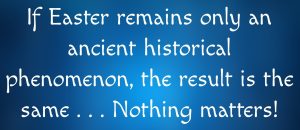 the power of Jesus’ resurrection somehow reached out to include individual folks like you and me. Paul said that if Christ was not risen, nothing matters! And … I might add that if Easter remains only an ancient historical phenomenon that doesn’t include you and me, the result is the same . . . Nothing matters!
________________________________
I hope you’ll join us next week as we continue our discussion and make our way toward Resurrection Sunday morning.
“TWEETABLES” ~ Click to tweet and share from the pull quotes below. Each one links directly back to this article through Twitter . . .
-
- We never witnessed the naked body of a man flogged nearly to death, nailed to a wooden cross to hang in agony until finally expelling his last breath. People in Jesus’ day saw it. The Romans made sure He wasn’t crucified on some “hill far away”. @GallaghersPen (Click here to Tweet)
- The suggestion that after three days in a tomb, Jesus somehow overcame all He suffered was more than shocking. It was a frontal assault on everything their world had taught them to believe about life and death – and that’s exactly what Jesus intended. @GallaghersPen (Click here to Tweet)
- Jesus called people to life with a different ultimate conclusion. He confronted and overcame every definition of unchangeable reality the world threw at Him, but the specter of death stood to mock His offer of life and erase the Good News of His coming. @GallaghersPen (Click here to Tweet)
- The resurrection isn’t just another amazing thing Jesus did. It’s the capstone that preserved ALL that He did and the foundation of ALL that He continues to do. @GallaghersPen (Click here to Tweet)
- If we treat the empty tomb, the angels’ announcement, and Jesus’ meeting with Mary Magdalene on that Sunday morning as the joyful ending to a painful story, then we’re stopping way short of what we need to see. @GallaghersPen (Click here to Tweet)
 Check out Ron’s book, “Right Side Up Thinking in an Upside Down World ~ Looking at the World through the Lens of Biblical Truth”


 Gallagher's Pen ~
As believers in Christ, and in His resurrection, we become Easter people, living each day with hope, joy, and knowledge of life everlasting beyond the here and now. Easter isn’t just one day, it is every day that we call ourselves Christians, because it is the foundation upon which we build our families, churches and communities. I’m most definitely looking forward to your next installment here, Ron, and I do pray that Diane is feeling much, much better. God bless you both!
LikeLike
You are so right about it not being just one day, Martha. Our Western Christianity has allowed so many things that have pagan roots, like Santa Claus and the Easter Bunny, to be inserted into our celebrations of the most theologically foundational and doctrinally vital events in human history. Small wonder that so many children grow up thinking that the virgin birth and bodily resurrection of Jesus is just another fantasy. God bless you and Danny for keeping the truth relevant and alive in your family and in the community of friends and fans that you guys have. And thanks for asking about Diane. She’s still not out of the woods yet, but she’s much better, and I’m approaching the point where I’m feeling close to normal again. Our pilgrimage had its unexpected twists and turns, but as I told one of our teammates in the midst of a challenging moment, “You don’t choreograph adventures–you just live them.” Thanks again, dear sister, for another energizing dose of encouragement.
LikeLiked by 1 person