If you were with us last week when we began our current trek with Jesus, you might recall that He was making His way to Jerusalem for Passover. He was accompanied by a large group of pilgrims and along the way, it became evident that the prevailing expectation among His followers was that the promised Kingdom of God was going to be established when they got to Jerusalem. That was troublesome for Jesus, because the glorious victory He would achieve would not look like the kind of triumph they anticipated. The reality that lay ahead would be shocking beyond anything they could have imagined. One thing was absolutely certain. They would be facing a plethora of uncertainties, and with that, Jesus decided to address the issue.
Not Just an Ancient Relic ~
As we mentioned in our earlier segment, one of Jesus’ preferred ways to deal with a problem, to demonstrate an important principle, or to prepare His disciples for some aspect of ministry, was to tell a story. His stories were packages of divine truth illustrated in little slices of life that would live on beyond the moment. Jesus knew that some of the same challenges awaiting the crowd surrounding Him then would also confront His followers in every generation until His return, including our own. This story is not just an ancient relic whose relevance has long since expired. Its message and its lessons are as vital for us here and now as they were when Jesus delivered them, and today we’ll endeavor to highlight at least one of those lessons and apply it in the context of the spiritual and moral atmosphere surrounding us today. But first, let’s return to Luke’s account and review how the story begins.
Now as they [Jesus’ followers] heard these things, He [Jesus] spoke another parable, because He was near Jerusalem and because they thought the kingdom of God would appear immediately. Therefore He said: “A certain nobleman went into a far country to receive for himself a kingdom and to return. So he called ten of his servants, delivered to them ten minas, and said to them, ‘Do business till I come.’ But his citizens hated him, and sent a delegation after him, saying, ‘We will not have this man to reign over us.‘ ” (Luke 19:11–14 NKJV)
Like so many of Jesus’ parables, this story is depicted in simple terms. A certain nobleman was about to take an extended trip in order to be officially designated as King and would return to reign over the entire region. The nobleman called ten of his servants and distributed a coin worth about three months’ wages to each of them. The only comment accompanying the 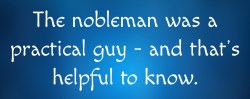 money was this simple directive, “Do business till I come.” That doesn’t seem like much to work with, but there’s one term that seems to reveal at least one important factor. The term translated business (Greek, pragmateúomai) is associated with our English word pragmatic, or pragmatism. It relates to things that are practical, down to earth, realistic, and productive, as opposed to those that are just philosophical, theoretical, academic, or intellectual. So, the text suggests that the nobleman was a practical guy – and that’s helpful to know.
Investments Expected ~
Because the story is allegorical, it demands that its message be interpreted and its lessons applied in the context of the world in which those who hear it live, but the basic elements are applicable in virtually every generation and culture. For instance, the nobleman didn’t give the money to the servants to hold in store for him until he came back. He intended it to be invested, and his practical nature suggests that he would be looking for an outcome that would be measurable in the same standard as the investment.
But before considering, in our own generation and culture, how to conduct the business we’ve been instructed to engage in, we should consider the challenging marketplace where the coming King’s resources are to be invested. To say the least, it would qualify as a toxic  environment because the prevailing attitude of the citizens in the region toward the nobleman was that they hated him. They underscored their intense disapproval by sending a “delegation after him, saying, We will not have this man to reign over us.” It was an act of public defiance and open rebellion. They didn’t just dislike the guy, they abhorred him and wanted him stripped of authority and banished from the land.
So, what’s the atmosphere looking like in the “spiritual marketplace” where we find ourselves today? A quick look around the country and asking what the prevailing attitude toward the God of the Bible has become might be revealing.
A Dismal Picture ~
There are radicalized political pawns and propaganda operatives at work once again. The current assault is described as anti-Israel, but it’s more than that. There are also anti-Christian, anti-American, anti-social, and pro-terrorist. They’re engaging in an ongoing, coordinated, multi-faceted assault on the bedrock values of our Judeo-Christian heritage. It’s another demonstration of how a group of well-funded, fanatically determined, and politically protected minorities can create havoc, spread division, fuel paranoia and silence spiritual expression throughout the population. This is what revolution and “insurrection” really look like – a widespread, in-your-face lawlessness and disregard for truth and justice that precedes the downfall of nations.
Our land is under assault by people who want to establish a fear-induced paralysis of freedom that results in subjugating masses of people to the will of a few. To say the least, it’s not the 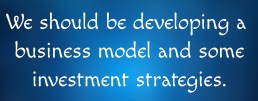 kind of atmosphere any of us wants to live and work in, yet the shocking truth is that it’s exactly the kind of environment where Jesus sent us to do business until He returns. So, rather than spending our days lamenting over the awful things we see and hear, we should be developing a business model and some investment strategies for putting what He has given us to work.
Not a What, but a Who ~
And speaking of which, let’s identify the incomparable gift God has given every one of us to do business with. The gift is a who not a what. The gift Jesus gave us is living, active, personal, and incredibly powerful, and Peter declared His arrival on the day of Pentecost:
Then Peter said to them, “Repent, and let every one of you be baptized in the name of Jesus Christ for the remission of sins; and you shall receive the gift of the Holy Spirit. (Acts 2:38 NKJV)
The command is to do business until the King returns, but what kind of business do we engage in with only the Holy Spirit as our primary investment resource? How about a fruit stand? This incredible resource we have has some products we can offer people. You already know what they are …
But the fruit of the Spirit is love, joy, peace, longsuffering, kindness, goodness, faithfulness, gentleness, self-control … (Galatians 5:22–23a)
The marketplace may be challenging, but the fruit we have to offer has incredible possibilities. For instance:
-
-
- A culture obsessed with hatred, division, violence, and fear might just be starving for some practical, real, non-toxic, sacrificial love?
- A people awash in depression, loneliness, anxiety, and mistrust might find some joy that isn’t artificially-induced, leaving no bitter aftertaste, to be priceless.
- A conflict-ridden, cancel-threatening, intimidating world might find a kind of peace that defies negative circumstances to be overwhelmingly desirable.
- In a culture where people scream at one another over trivia and attack one another over inconveniences, a dose of patience and kindness might be more than welcome.
-
Not Spiritual Capitalism ~
What we’re called to do isn’t “spiritual capitalism”. It’s not a situation in which we’re offering something for less than what we paid for it and go home smiling with our profit in hand. Our business is quite different. It’s to pour everything the Spirit of God has put in us into the emptiness of others. It’s to invest all we’ve been given in the hope that those who receive it will do more with it than we ever could. Our goal is not to enrich ourselves, but to ensure that when the King comes back, He’ll find that His investment in us was not in vain.
We’ll continue our exploration next week, but until then, may God help us all to be faithfully doing the King’s business until He comes.
“TWEETABLES” ~ Click to tweet and share from the pull quotes below. Each one links directly back to this article through Twitter . . .
-
- “The story demands that its message be interpreted and its lessons applied in the context of the world in which those who hear it live, but the basic elements are applicable in virtually every generation and culture.” @GallaghersPen (Click here to Tweet)
- “The nobleman didn’t give the money to the servants to hold in store until he returned. He intended it to be invested. His practical nature suggests that he would be looking for an outcome measurable in the same standard as the investment.” @GallaghersPen (Click here to Tweet)
- “Our business is to pour everything the Spirit of God has put in us into the emptiness of others. It’s to invest all we’ve been given in the hope that those who receive it will do more with it than we ever could.” @GallaghersPen (Click here to Tweet)
- “Our business is to pour everything the Spirit of God has put in us into the emptiness of others . . . Our goal is not to enrich ourselves, but to ensure that when the King comes back, He’ll find that His investment in us was not in vain.” @GallaghersPen (Click here to Tweet)


 Gallagher's Pen ~
You had me shouting “Amen” with every point and paragraph sir. In usual fashion you too have the gift of taking the complex and writing it in simple terms that even a knucklehead like me can understand. If I had to boil your message down to one statement, it would be, “As true Christians, our job is to pour into others every bit of what God has poured into our lives. In doing so, we make investments in eternity that will reap untold riches for His kingdom. All for His glory.”
Sadly, very few do this today. Oh, some of us make an effort, but the worldliness that still exists within us of keeps us from “selling out for God.” Instead, many of us are like the rich Pharisee who gives from his abundance and not from his heart. God doesn’t want or need our leftovers, does He my friend? He wants us to give our all to Him, in His service.
I have to wonder if more of us had done that fifty or more years ago, if our world, our children, grandchildren, and great grandchildren would be much different than they are. Then too, had we then not surrendered to worldly opinion and values would Christ be any closer to returning? One thing is for sure. If we start this day, His harvest will be greater.
I often pray that God help me make sure that when He returns, He finds me tilling His field and sowing His seed. I pray He finds us doing kingdom work and not simply withholding the treasures He entrusted us with.
Such a powerful message in this series, my friend. Thank you for sowing into me and so many others. God’s blessings upon you, Ms. Diane, and the entire Gallagher clan.
LikeLike
I couldn’t help but think of you when I was writing this piece, even my limited awareness of your life reveals a fascinating mosaic of different J.D. pursuits, endeavors, employment, and pastimes and in all of them, it’s easy to see the dispensing of God’s gifts in so many ways. Like you, I often wonder what kind of world we would be leaving behind if I, and others like me, had been more aware of what was going on beneath the surface and how important it was to be more conscious of what my real spiritual responsibilities were. But we don’t have time machines and can’t retrace our steps, can we? What we can do, though, is to keep sowing the seeds we’ve been given and keep using the gifts He has put in our hands.
Diane and I are so blessed once again to hear from you, and encouraged, of course. We’re still praying about that book you have in your heart and for God’s direction and empowerment to get it published and into the hands of that multitude of people He wants to read it. It’s just one more way you get to pour all that fascinating stuff inside you into the hearts and lives of others. The living God has made an incredible investment in us, my friend, and here’s no greater return we can ever produce than to allow Him to put it to work in His Kingdom in whatever way He chooses. Thanks for making our day once again, Brother. Mrs. Diane and I are praying that you and the Cross-Dubya haven’t been damaged by the storms we keep hearing about down there, and that your weekend is safe, uplifting, and full of reasons to smile.
LikeLike