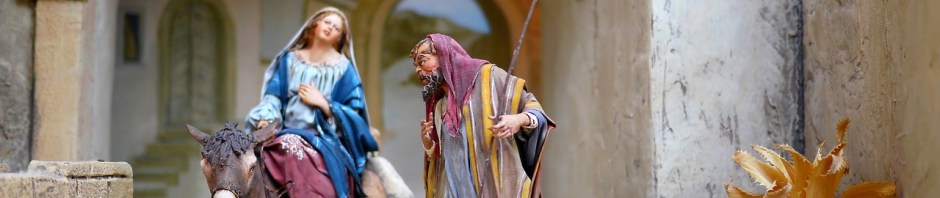
It’s hard for us “Westerners” to relate to what day-to-day life in Bethlehem was like for those living there when Joseph and Mary arrived, but if we’re to understand the Christmas story as it actually unfolded, it’s profoundly important that we address some of the realities that governed their public and private interactions with one another at that time.
One Thing We Know ~
One of the things we tend to accept about Bethlehem without considering its impact on the Christmas story is its size. Our familiar Christmas song, “Oh Little Town of Bethlehem,” is probably accurate. The Prophet, Micah, described the town as little (Micah 5:2) hundreds of years earlier, and by the time Joseph and Mary showed up, Bethlehem remained a small, close-knit, family-oriented, agrarian community. Like most of the Middle East at that time, Bethlehem’s social structure was very communal, and hospitality was a universally encouraged, recognized, foundational concept. In contrast to phrases in our individualistic culture like, “What happens in Vegas, stays in Vegas,” Bethlehem’s residents could have said, “What affects anyone in Bethlehem affects everyone in Bethlehem.”
Luke called Bethlehem “the City of David” (Luke 2:4 NKJV), which is interesting, because the same phrase was also used to refer to a specific section of Jerusalem. Luke employed the term in reference to Bethlehem because being the place of David’s birth was the town’s signature event. In spite of its small size and lack of political or economic significance, every Jew would have learned about Bethlehem. From early childhood, Jewish children were taught about their religious, tribal, and national history, including the lineage of those leaders associated with God’s covenant relationship with Israel, and that included David.
Bethlehem was not only David’s birthplace, it was also Joseph’s hometown, and everyone living there would have known about him and his family. Middle Eastern historical and cultural theologian, Dr. Kenneth Bailey, suggests that Joseph’s direct line lineage to David would have made him like royalty in Bethlehem, and this plus their cultural standards of hospitality certainly would not have allowed Mary’s pregnancy to be ignored. He writes this:
In every culture a woman about to give birth is given special attention. Simple rural communities the world over always assist one of their own women in childbirth regardless of the circumstances. Are we to imagine that Bethlehem was an exception?… …Surely the community would have sensed its responsibility to help Joseph find adequate shelter for Mary and provide the care she needed. To turn away a descendent of David in the “City of David” would be an unspeakable shame on the entire village. (Bailey p.26)
Beyond that, neither the language of the text nor the culture of the time support the story we  hear repeated every year. In the first place, that an “inn”, as depicted in the traditional story, even existed in the small town of Bethlehem in those days, is extremely unlikely. Although those kinds of “pay to stay” establishments did exist, virtually all of them were situated on Roman roads and in larger towns and cities. Bethlehem met neither of those criteria. Beyond that, the text itself presents a different narrative.
Looking into the original Greek word for inn that God inspired Luke to use in the birth narrative is not the same Greek word used to describe the kind of inn (or lodging place for travelers) that we usually think about. The appropriate Greek term for that kind of establishment is pandocheíon – which is the same word Luke used in describing the inn where the wounded man stayed in Jesus’ parable of the Good Samaritan:
So he went to him and bandaged his wounds, pouring on oil and wine; and he set him on his own animal, brought him to an inn (pandocheion), and took care of him. (Luke 10:34 NKJV)
But to describe Joseph and Mary’s situation, Luke used the word, kataluma, which is the Greek word commonly used to describe the guest chamber found in almost every home in Bethlehem at that time. Kataluma is the same word appropriately chosen to describe the room where Jesus met with the disciples for the last supper:
Wherever he goes in, say to the master of the house, ‘The Teacher says, “Where is the guest room (kataluma) in which I may eat the Passover with My disciples?” (Mark 14:14 NKJV)
Then he will show you a large, furnished upper room (kataluma); there make ready. (Luke 22:11–12 NKJV).
Seeing Joseph and Mary arrive at a house where there was no more space in the “guest room” begins to paint a very different picture.
Not the Only Option ~
It isn’t surprising that guest rooms were filling up, given Caesar’s decree. Bethlehem was in the midst of experiencing the greatest family reunion the town had ever seen! Space would have been offered in the guest chambers (katalumas) of every home as long as there was room to be found. But the comment that there was no room for them in the ‘kataluma’ didn’t mean Joseph and Mary were turned away, rejected, or ignored. In that culture of expected hospitality, such a thing would have been inconceivable under any circumstances, but especially so in the case of a pregnant woman. But if the kataluma was full, there was another option that could have been offered.
Obviously, the guest chamber wasn’t the only room in houses in Bethlehem. Homes at that time usually had a large living area where the main family members cooked, ate, and slept. The guest chamber was often built on a somewhat higher level or located behind or to the side of the family’s living area. Joseph and Mary would reasonably have been invited to share the family’s main living quarters. That would have been the expected response from almost anyone in Bethlehem, but, in the absence of an actual “inn”, it’s inconceivable that Joseph showed up and knocked on the door of some random person’s house.
A Natural Response ~
Under normal circumstances even in our day, if we had to return to our hometown for a mandatory, unexpected visit and there were no hotels, where would we look first for lodging? If we had any family members living there, we’d naturally seek them out first. It would have been no different in Bethlehem when Joseph and Mary arrived, and perhaps even more likely. Given that Joseph was born there, it’s very unlikely that he had no family members living there. Actually, there could have been several, and any one of them would have received him and Mary with open arms and glad hearts. If their guest chamber was already occupied, they would have invited the couple into the family’s living quarters.
But there’s another question. What about the manger and those sheep and goats and camels? Well… the text doesn’t actually mention that any animals were hanging around swaying to the beat of the little drummer boy (who, by the way, wasn’t there, of course) as they watched Jesus come into the world. But animals may not have been far away. Homes in Bethlehem had a  protected area for animals, often a cave-like structure upon which the main living quarters were built. That area was removed from, but accessible to, the main living quarters. It allowed livestock to be brought in for shelter from the elements, protection from predators at night, and to prevent them from wandering off or being stolen. And every home would have been equipped with mangers. Some were hewn out of stone, and others were wooden troughs. They were often positioned at the edge of the living quarters in order to more easily keep them supplied and monitor the animals’ access to them. Laying the Baby Jesus in a manger in that culture at that time made perfect sense. It would have been close, convenient, and functional.
A More Encouraging Picture ~
Seeing the text in its cultural context suggests that a lack of space in the guest chamber would have resulted in Joseph and Mary being invited into a family’s living quarters, perhaps (or most likely) belonging to one of his relatives. As we mentioned in our last segment of revisiting the Christmas story, there is no indication in the text that Mary gave birth virtually upon arrival. She could have been in Bethlehem for days, perhaps weeks, prior to her delivery, and would have been surrounded by experienced women caring for and assisting her.
God was sending His Son into the darkness of this world to seek out the lost, the rejected, and the outcast and bring them into His family. Instead of leaving Mary and Joseph alone, cold, and helpless on this special, holy night, wouldn’t it be just like our loving Father to bring them into warmth, surrounding this beautiful baby, like no other, with a family ready to receive Him, care for Him, and celebrate His coming?
Maybe one of the lessons God wanted to teach the residents of Bethlehem, and all the rest of us, is that obeying that admonition to love our neighbor as ourselves sometimes means inviting someone in need into our personal space. But what grander message could Christmas convey than a story of how an ordinary family’s willingness to confront someone’s unexpected crisis with sacrificial compassion brought the Light of the World right into their living room! As we ponder the richer, fuller story of the glorious miracle of that night, what more beautiful way could we adorn the celebration of Jesus’ birth than to live out the lesson of that story in our own lives?
Next week … Our series continues with Part 4, Drop-in Visits, Shocking Announcements, and News You Can Use. Meanwhile, please feel free to share your insights and questions in our comments section.
Work Cited: Bailey, Kenneth E. Jesus Through Middle Eastern Eyes. Downers Grove, Ill, Intervarsity Press, 2008.
“TWEETABLES” ~ Click to Tweet & Share from the pull quotes below. Each quote links directly back to this article through Twitter.
-
-
- “Instead of leaving Mary and Joseph alone, cold and helpless on this special, holy night, wouldn’t it be just like our loving Father to bring them into warmth, surrounding this beautiful baby with a family ready to receive, care for, and celebrate His coming? @GallaghersPen (Click here to Tweet)
- “Maybe one of the lessons God wanted to teach the residents of Bethlehem and all the rest of us is that obeying that admonition to love our neighbor as ourselves sometimes means inviting someone in need into our personal space.” @GallaghersPen (Click here to Tweet)
- “What grander message could Christmas convey than the story of how an ordinary family’s willingness to confront someone’s unexpected crisis with sacrificial compassion brought the ‘Light of the World’ right into their living room!” @GallaghersPen (Click here to Tweet)
-
-
 Check out Ron’s book, “Right Side Up Thinking in an Upside Down World ~ Looking at the World through the Lens of Biblical Truth”
 The Kindle e-version is just $1.99. No Kindle device is needed. E-book readers are included on most computers, tablets, and smartphones. If you don’t have one, the free Kindle app can be easily downloaded directly from the Amazon site on almost any device.
Click here for a “Look Inside” preview at Amazon.


 Gallagher's Pen ~