At times, being around Jesus must have been like being handed a pair of spiritual binoculars. He enabled people to see things they had never seen, and to have a clearer view of vital details that had been blurry and obscure to them. In His presence, familiar and insignificant scenes often developed a compelling fascination. Through the lens of His words and actions, Jesus gave people a closeup view of what the Kingdom of heaven is really like. And for multitudes, that vision changed everything.
A Familiar Analogy ~
I mention that to suggest that there is another way to think about a familiar comment that Jesus made about one of His favorite analogies regarding the Kingdom of heaven. All three of the synoptic gospel writers included it as one of Jesus’ parables. Mark and Luke’s accounts can be found in Mark 4:30-32 and Luke 13:18-19. Matthew recorded it like this:
Another parable He put forth to them, saying: “The Kingdom of heaven is like a mustard seed, which a man took and sowed in his field, which indeed is the least of all the seeds; but when it is grown it is greater than the herbs and becomes a tree, so that the birds of the air come and nest in its branches.” (Matthew 13:31–32 NKJV)
In all three instances, when Jesus chose to employ mustard seeds as a visual aid, He used the appropriate word, “like”. He said, The Kingdom of heaven is like a mustard seed, meaning that something about the Kingdom of heaven is revealed in the features, characteristics, or qualities of a simple little mustard seed. But those aren’t the only instances where Jesus reached for this tiny little teaching tool to make a point. For instance…
So the Lord said, “If you have faith as a mustard seed, you can say to this mulberry tree, ‘Be pulled up by the roots and be planted in the sea,’ and it would obey you. (Luke 17:6 NKJV).
So Jesus said to them, “Because of your unbelief; for assuredly, I say to you, if you have faith as a mustard seed, you will say to this mountain, ‘Move from here to there,’ and it will move; and nothing will be impossible for you. (Matthew 17:20 NKJV)
One Small Difference ~
 It’s easy to read these two accounts and not notice that there’s a small change in the language (both Greek and English) that can affect how we view what Jesus is teaching and how we respond to the lesson. Instead of using the term like in the comparison to a mustard seed, Jesus used the term as. The ultimate objective of the mustard seed lesson from either perspective is similar, but the difference in how we handle the personal application can be significantly different, and that difference is worth considering.
When we hear terms like the Kingdom of heaven, our minds usually envision a vast and inclusive reality that is out there waiting for us someday. But on the two occasions quoted above where Jesus uses the term mustard seed, He doesn’t mention the Kingdom of heaven at all. In these two instances, Jesus is He talking about something present, deeply personal, and profoundly powerful. Jesus chose to connect the characteristics of a mustard seed, with their concept of faith, and to its potential when activated in each of them.
Nouns or Verbs? ~
And regarding the concept of faith, it’s important to understand that the way Jews have approached the idea of faith historically (and presently as well) and the way most of us Westerners look at it is very different. We Westerners generally think of faith as something we  have, a stated belief system we hold, or set of doctrines we ascribe allegiance to. We treat faith as a noun. But the Jews (a designation which includes Jesus Himself and nearly every writer of Holy Scripture) viewed faith more as a verb. Faith, to them, was not just something you have. Faith was something you do. So, when Jesus was talking about faith, He was speaking to them in behavioral terms. Jesus’ audience understood that, but I’m afraid many of us fail to see it that way or even think of it in those terms, and thus, miss the incredible picture that I believe Jesus unveiled that day.
I recall the first time I was ever put in charge of anyone (other than myself) in my employment career. One day my boss decided to make me the official “Team Leader”. When my training included new activities and responsibilities specifically attached to my new role, they were prefaced with a comment like this: “Now as Team Leader, you will …” That meant that when it came to certain functions, I was to see myself in the context of the authorities and responsibilities associated with my role as Team Leader. On those occasions, being the Team leader encompassed everything about who I was and why I was there. Now, when we apply that approach to faith and mustard seeds, the lesson gets a lot more interesting.

Another Look at the Picture ~
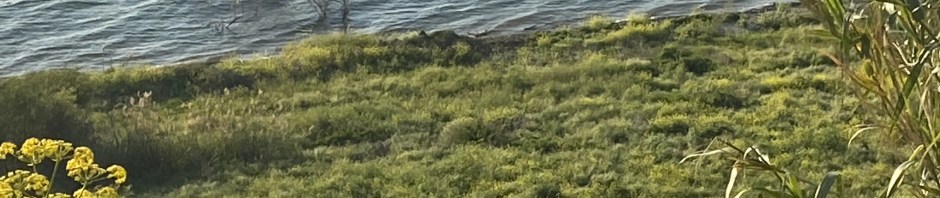
Before we go further, look at the picture above. It’s a scene from our trip last year to the Holy Land. Those yellow flowers are mustard plants and they are the source of that pervasive yellow tint that stretches out across the countryside. Except for the extremely arid regions of Israel, mustard plants are virtually everywhere. My favorite authority on Israel and its culture says this about mustard plants, “Mustard is like Jewish kudzu. It grows extremely fast, and it will grow ‘in front of you, behind you, beside you, under you, around you, and if you stand still long enough, it will probably grow on you and up you.”
In applying the illustration to faith, we Westerners always get caught up in analyzing the size of the seed. We make comments like, “If we only had a little bit of faith, look what we could accomplish,” But what if we saw it differently? Instead of asking how big the seed is, what if we asked what else the seed might represent? And as He revealed in other places, Jesus clearly had more than seeds in mind. In one instance, the seed represented the Word of God (Luke 8:11). And in His parable about wheat and tares, seeds are people … like you and me.
He [Jesus] answered and said to them: “He who sows the good seed is the Son of Man. The field is the world, the good seeds are the sons of the Kingdom… (Matt 13:37–38 NKJV).
The seeds are different and the lessons associated with their characteristics are different, but  regarding mustard seeds and faith, the personal admonition is clear. He said if YOU have faith… The lesson here isn’t generalized. It’s personal. What if the seeds in the mustard plant illustration are intended to teach us not only about the incredible potential that lies in something we have, but something He built into who we are and who we can be for His Kingdom?
Different Perspective–Different Response ~
When I think about that parable in those terms and recall the pervasive yellow hue that fills so much of Israel’s landscape, it’s breathtaking. When I look at a yellow mountainside and ask, “How did that get started?”, I’m overwhelmed with the knowledge that no one but God knows. Not one of us could isolate which single, tiny, insignificant seed fell into the dirt first and give it credit for taking over that mountain.
Suppose Jesus was saying to them and us, “You guys want to own that mountain? Go be the seed I designed you to be! Do you want victory over the mountainous opposition confronting you? Then stop complaining about the size of the mountain and whining about the tiny, insignificant thing you look like. Go settle into the dirt where I put you and turn loose the power I built into you! Start sending out, in every direction, the things I put in you – in front of you, behind you, around you – and up the devil’s pant leg if you need to! Then step back and watch that mountain turn into something beautiful.”
“TWEETABLES” ~ Click to tweet and share from the pull quotes below. Each one links directly back to this article through Twitter.
-
- “The Jews (a designation which incl’s Jesus Himself & nearly every writer of Holy Scripture) viewed faith more as a verb. Faith, to them, wasn’t just something you have. It was something you do. When Jesus talked about faith, He was speaking in behavioral terms.” @GallaghersPen (Click here to Tweet)
- “The Jews viewed faith more as a verb. Faith wasn’t just something you have but something you do. Jesus’ audience understood that He was speaking in behavioral terms, but many of us don’t understand that & miss the incredible picture that Jesus unveiled that day.” @GallaghersPen (Click here to Tweet)
- “Jesus clearly had more than mustard plant seeds in mind. In one instance, the seed represented the Word of God (Luke 8:11). In His parable about wheat and tares, the seeds are people like you and me.” @GallaghersPen (Click here to Tweet)
- “Jesus said, ‘If YOU have faith’ The lesson here is personal. What if the seeds in the mustard plant illustration are intended to teach us not only about the incredible potential that lies in something we have but something He built into who we are and who we can be?” @GallaghersPen (Click here to Tweet)
 Check out Ron’s book, “Right Side Up Thinking in an Upside Down World ~ Looking at the World through the Lens of Biblical Truth”


 Gallagher's Pen ~
Interesting enough, when I looked at the photo from Israel, my mind went to many pastures around me this year. While we call fight against nightshade and goatweed every year, I was overwhelmed by a sea of yellow that engulfed so many of my neighbors’ pastures this year. With the heavy rains of winter, spring, and even into early summer, the weeds have been on overdrive. One in particular that has invaded my part of the world is bitter sneezeweed (aka bitterweed). Cows won’t eat it, you don’t want to roll it up into hay (it’ll spread like crazy), and it robs precious nutrients and moisture from the ground. It doesn’t grow into a tree like the mustard plant does, but it sure does seem to take over less fertile pastures. Of course, like most weeds, you have to do more than cut it, you have to kill it. Otherwise, it will spread like crazy and invade neighboring pastures. So, I grab a few gallons of Grazon (herbicide) and go to work. Anyway, onto mustard seeds.
As I was reading your insightful post, I thought of how different it is when we consider faith to be “what we do” rather than merely “what we have.” As I thought about it, I found myself asking how much do I really put my faith into action? How much do I use it? Just a small amount like a mustard seed, or do I let it expand, like when we let the plant mature and its seeds fall to the ground and creates more plants? In that same way, I can rely on my faith to sustain me or I can share my faith with others, planting seeds of faith into others. Seems to me that is a better use of my gift of faith. God doesn’t say to take care of myself, He encourages me to take the gospel to the world and make disciples. That, my friend, requires my use of the faith God has given me. And like any plant, the more I feed it (water, nutrients, etc.) that stronger it grows and becomes.
What a great lesson you share this week. Thank you for once again sharing your wisdom with us my friend. God’s blessings and prayers for good health for you and your precious wife Ms. Diane.
LikeLike
Your responses have a tendency to kick in fascinating things I hadn’t thought about, and your gracious comments today have kept that track record alive and well. Mentioning the weeds you have to fight every year to keep your cattle fed and your ranch productive brought back memories of articles you’ve shared about one aspect or another of that challenging and frustrating battle. It reminded me of how the devil sees God’s mustard seeds and the reproductive potential in the plants they represent. We are the devil’s “sneezeweed”. We interfere with his productivity. We challenge the viability of his system. We cut into his “profit margin.” We pull the energy out of his deceptive enticements. We irritate and frustrate him. And to all that, I shout a heartfelt Hallelujah! But there’s a warning in that picture as well.
In light of that shift in perspective, something you said about the sneezeweed is sobering. You remarked that, “you have to do more than cut it, you have to kill it.” That’s something we don’t think about as much as we should when we’re faced with the devil’s alluring trinkets. He doesn’t just want to cut us back a bit. He wants to obliterate us, to kill us off and not only eliminate any impact our individual presence might be having. He wants to remove any hint of our presence and any possibility of reproduction. When we talk about spiritual warfare, it isn’t just a topic for a Sunday School discussion. The devil is doing more than just sowing his toxic weeds. He’s got an extermination project going on against every seed and every plant that the Lord is planting.
You have such a way of stimulating our imagination, J.D. and we absolutely love the way God uses you to do that. Thank you again for sending us another dose of very welcome encouragement and inspirational insight. Our prayers for you, your Diane, and everyone in or around the Cross-Dubya continue as does our confidence that the faith you demonstrate is bearing abundant fruit.
LikeLike
I so love this analogy regarding the mustard seeds, Ron. I had never looked at it this way before! And thinking of the word “faith” as a verb? Well, that changes lots of things in my heart and mind, all for the better. While I was reading, the phrase “Be fruitful and multiply” came to mind. To spread God’s kingdom, we must be active and productive with the gifts He’s given us, and encourage others to do the same.
Great reflection today, my friend!
LikeLike
Sorry, again, for being late responding, Dear Friend. I read this on the road but don’t do well responding to things on my phone, so I though I’d wait till we got back home. I’m always humbled and encouraged by your reactions and it’s once again reinforcing to know that we’re on the same page about so many things. James said, basically, that if our faith isn’t active, it’s worthless. So many seem to think that showing up for an hour or two a week is “serving” the Lord. It’s a good thing, and I thank God for everyone that finds his or her way to a place where they can join in to worship God and to hear His Word expounded, but that’s just a beginning place. As you know, the real “service” is meant to unfold and multiply all week. Once again, as you characteristically do with all your fans, you’ve strengthened the bond we share and revitalized the faith we both seek to demonstrate and we are grateful for both. God bless you and your fella as you serve Him together.
LikeLiked by 1 person